
Park home insulation: options, funding and costs
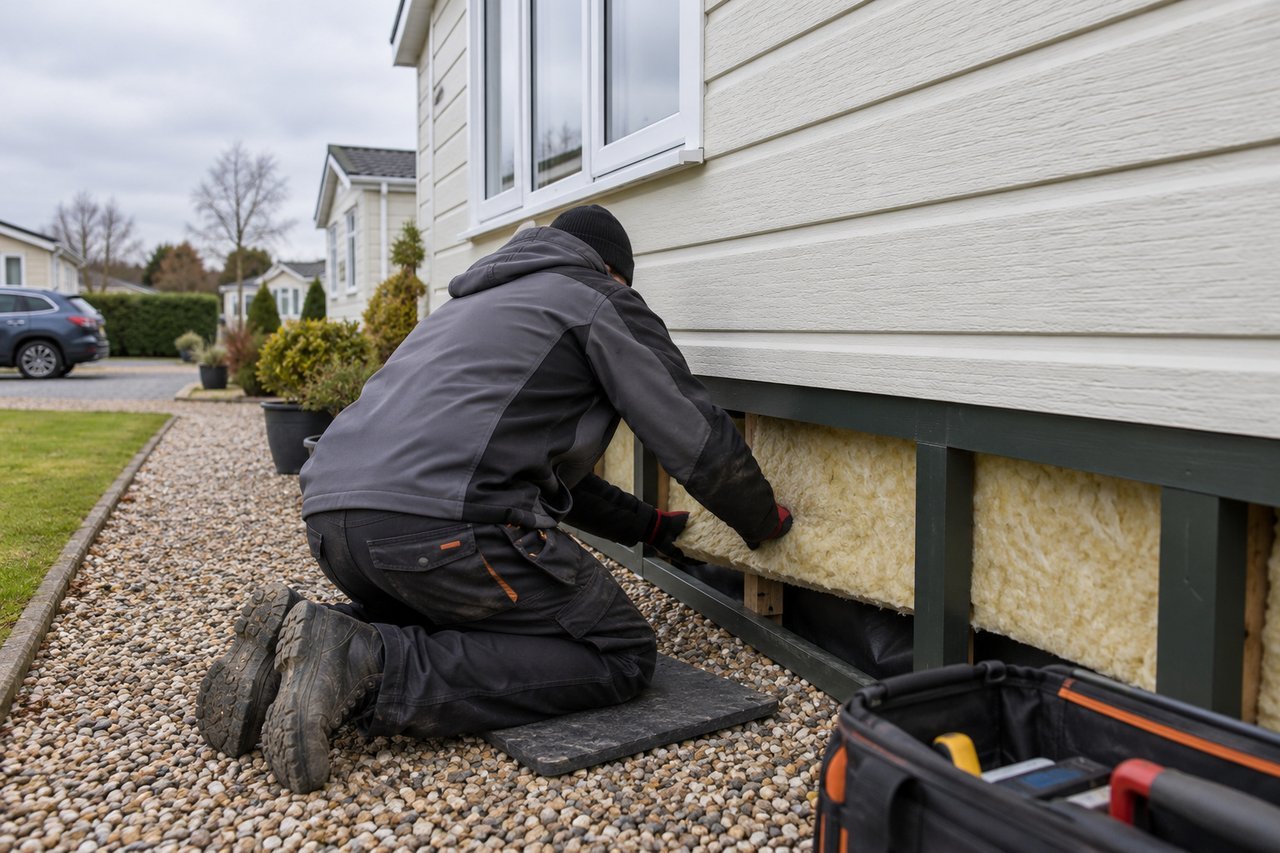
Park home insulation works differently from a brick house, because the walls, roof and floor are lightweight and the home sits on a pitch. Heat escapes quickly through all three. This page explains the main methods, how funding works and what researched costs look like.
Last checked: 22 October 2026.
Book a free retrofit assessment
Why park homes lose heat
Most park homes are built from a timber or steel frame with thin walls, a low-pitched roof and a floor raised above the ground. There is no cavity to fill and no loft to top up in the usual way. Heat therefore leaves through walls, roof and floor at once.
Many older park homes also have limited insulation behind the lining. A survey checks what is there before any advice is given.
A light frame also cools quickly once the heating goes off. Insulation slows that loss, so the home needs less heat to stay comfortable. For roof detail, see our roof insulation guide, and for gaps around doors and windows see draught-proofing.
The main park home insulation methods
| Method | What it does | What we check first |
|---|---|---|
| External wall cladding | Adds insulation outside the frame and a new finish | Frame condition, damp, pitch rules |
| Roof insulation | Insulates the roof void or adds a new insulated roof layer | Roof covering, ventilation, load |
| Underfloor insulation | Insulates between floor joists from below | Access, services, belly board condition |
| Draught-proofing | Seals gaps around doors, windows and vents | Ventilation, extractor fans |
This table is our summary of standard methods. An assessor confirms what suits your home.
Park home wall insulation and cladding
Park home wall insulation is usually fitted outside, as a cladding system fixed to the frame. It leaves the interior untouched, so the household can stay in the home during the work. The finish can be changed at the same time.
Check three things before work starts. First, the frame must be sound and dry. Second, the site owner may need to approve changes to the outside. Third, ventilation must stay in place.
Who pays: owners, site owners and landlords
Most park homes are lived in by their owners. A few are let, so the energy performance rules for private rentals can apply to those homes. If you are a landlord, check the status of the home before you plan work.
Owners usually need the site owner's written permission for external changes. Ask early, because it can affect the schedule.
Park home insulation grants and funding
Park home work has often been funded through the Energy Company Obligation, known as ECO4. ECO4 closes on 31 December 2026, so check eligibility soon. Eligibility depends on household income or benefits and on the home.
In Greater Manchester, the GMCA Warm Homes Local Grant also funds energy work for eligible private rentals. It applies to landlords who sign up to the Good Landlord Charter and to homes rated D or E. See our grants for landlords guide and Warm Homes Local Grant guide. We do not promise funding. The assessment shows what you may qualify for.
Park home insulation cost: what the research found
Published figures for park home insulation differ widely, so we show ranges and their sources, not a single price.
| Work | Figure found | Source and date |
|---|---|---|
| Cladding only | £1,500 to £3,500 | Axiom Eco Homes, May 2026 |
| Full external wall system | £10,000 to £14,000 | Checkatrade, 2024 (older) |
| Wide range across all park home work | £1,400 to £15,000 | GreenMatch |
These are market figures, not our quote. Size, system and access change the price. Our written price follows the survey, and where a grant applies we show your share before work begins.
How the process works
- Assessment: an assessor inspects the frame, roof and floor.
- Scope: a written list names every measure and who pays.
- Funding check: we check ECO4 and local grant routes.
- Fitting: LAMTANS Engineering Ltd installs and hands over certificates.
Who delivers the work
Compliant Lets is a trading name of LAMTANS Holdings Ltd. The work is delivered by LAMTANS Engineering Ltd, which holds PAS 2030, PAS 2035 and TrustMark.
Adviser tip, from a Retrofit Coordinator: ask for the site owner's written permission before you book any external work. A quote can be perfect and still be stopped by a missing consent.
Sources
- GOV.UK: Improving the energy performance of privately rented homes, government response, checked 22 October 2026
- GMCA: Warm Homes Local Grant, privately rented scheme, checked 21 October 2026
- Ofgem: Energy Company Obligation, checked 22 October 2026
- Checkatrade: park home insulation cost, 2024 figure, checked 3 to 7 October 2026
- GreenMatch: park home insulation cost, checked 3 to 7 October 2026
Designed & developed by LAMTANS Technologies LLC, USA — part of the LAMTANS Group
Frequently asked questions
Can a park home be insulated?
Yes. Walls, roof and floor can all be treated. The method differs from a brick house, so a survey of the frame, roof and floor comes first.
Do I need the site owner's permission?
Often yes for external changes such as cladding. Check your agreement and ask in writing before booking any work.
Is there a grant for park home insulation?
Possibly. ECO4 has funded park home work for eligible households, and it closes on 31 December 2026. Eligibility depends on your circumstances.
Can I stay in the home during the work?
Usually, for external cladding, because the inside is left alone. Roof and floor work may need short access. We agree the plan first.
Will insulation cause damp?
Poor installation can. Frames must be dry, ventilation must stay open and fitting quality matters. The survey checks for damp first.
How much does park home insulation cost?
Published figures range from £1,400 to £15,000, depending on the system and size. We give a written price after a survey.
Does the EPC C rule apply to park homes?
It can apply to a park home that is let as a private rental. Owner-occupied homes are not covered. The rule is confirmed policy, not yet law.
How long does the work take?
It depends on size and method. The written scope gives a timetable before you commit.