
Solid wall insulation landlords: choosing internal, external or hybrid
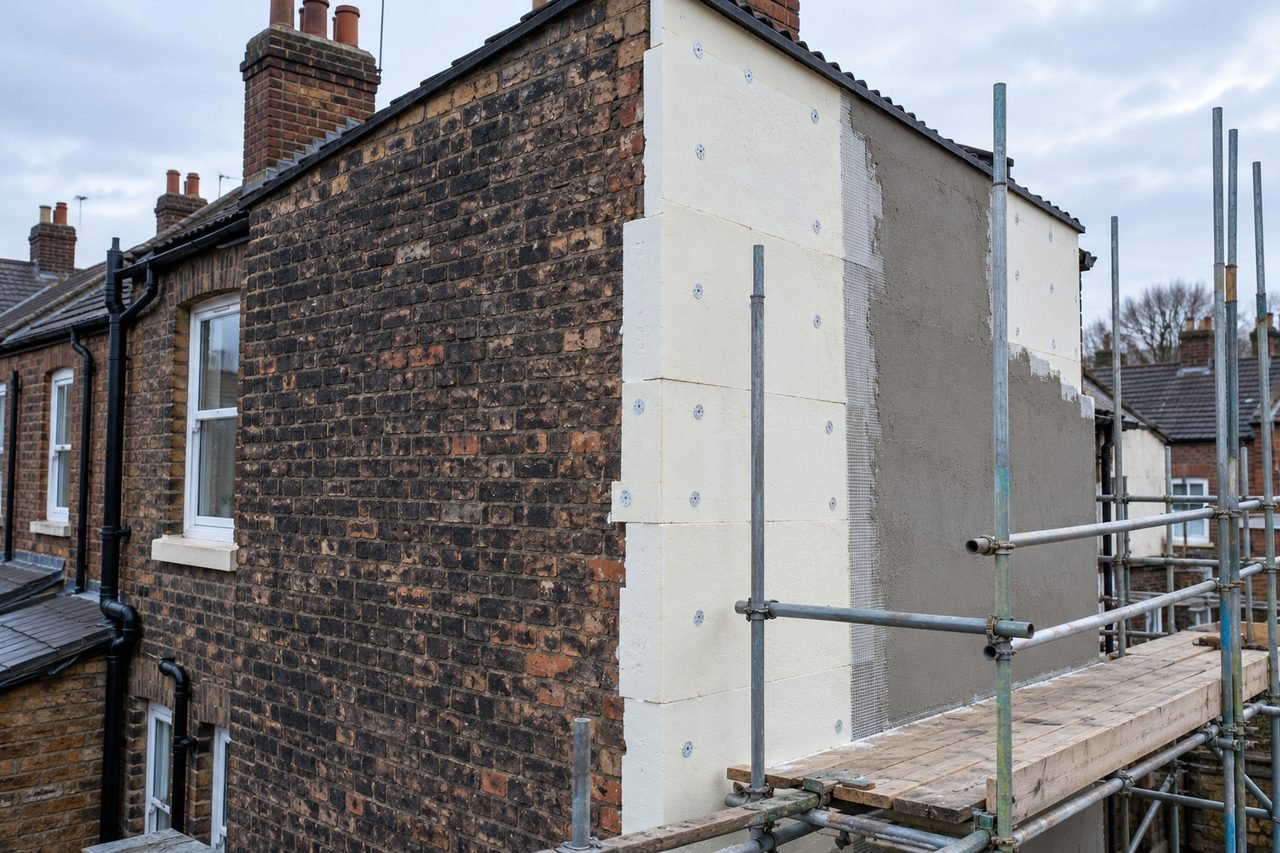
Solid wall insulation landlords need to weigh up is the hardest fabric job on the EPC C list. It is costly, it changes how a wall behaves and it can go wrong without a proper survey. This page sets out the options, the damp risk and the exemption that may apply.
Last checked: 21 October 2026.
Book a free retrofit assessment
How do I know my walls are solid?
Solid walls have no gap inside them. Look at the brickwork. If some bricks are laid sideways so their short ends show, the wall is probably solid. Cavity walls usually show bricks laid lengthways in an even pattern.
Thickness helps too. A brick wall of about 260mm to 350mm is likely to be a cavity wall. Narrower brick walls are probably solid. Stone walls are usually solid, even at 500mm thick. Our assessor confirms this on site. If you find a cavity instead, see cavity wall insulation.
Internal wall insulation, external wall insulation or hybrid
There are three ways to insulate a solid wall. The Energy Saving Trust gives typical costs for a three-bed semi in Great Britain. They are guide figures, not our prices.
| Option | What it is | Guide cost | Main drawbacks |
|---|---|---|---|
| Internal wall insulation | Boards or battens fixed inside the outer walls | About £12,000 | Rooms lose some floor space and are unusable during work |
| External wall insulation | Insulation and a weatherproof finish on the outside | About £15,000 | May need planning permission; changes the look of the house |
| Hybrid | External on suitable walls, internal on the rest | Quote only, after a survey | Two methods to design and join up |
Source: Energy Saving Trust, page updated 18 June 2026, checked 21 October 2026.
Internal wall insulation
Internal wall insulation suits a rented home between tenancies, when rooms are empty. Skirting boards and door frames come off and the walls need redecorating. It can make the original brickwork colder, so moisture can build up inside the wall if the detailing is poor.
External wall insulation
External wall insulation leaves the rooms alone and can be fitted with the tenant at home. It is cheaper to fit when scaffolding is already up for roof or gutter work. Check planning rules first, especially in a conservation area.
Hybrid insulation
A hybrid job treats the back and sides externally and the street-facing wall internally. It is one answer where the front must keep its original brickwork.
Victorian terrace insulation: the hard case
Victorian terraces are the typical hard case in Greater Manchester. Many have solid brick walls, bay windows, shared party walls and little spare room inside. The front elevation may be protected by a conservation area.
Three problems come up again and again:
- Narrow rooms mean internal insulation takes a visible share of the floor.
- A small area of wall can still carry high fixed costs, such as scaffolding.
- Old brickwork absorbs and releases moisture, so the wrong system can trap it.
For this reason we survey the whole house first. We often recommend loft insulation, floor work and draught-proofing before any wall measure. See loft insulation for the first of those.
Is there a damp risk with solid wall insulation?
Yes, if the job is done badly or on a damp wall. Both internal and external systems need existing damp fixed first, and exterior repairs such as gutters and pointing done beforehand. Installers must not block airbricks, wall vents or trickle vents.
Ventilation may need a fresh look after the work. Our damp, mould and ventilation guide explains how we check.
How does solid wall insulation affect an EPC?
Wall insulation reduces fabric heat loss, and fabric performance is the primary standard on the new EPC. That is confirmed government policy, not yet law. The thresholds are not published, so we do not quote points.
Landlords must meet the fabric standard first. Only then does a second standard on heating or smart readiness apply.
The solid wall insulation exemption
The government's response of 21 January 2026 confirms a solid wall insulation exemption. It is aimed at landlords of solid wall homes who do not wish to install it. It applies where this is the only remaining measure needed to meet the fabric standard.
Status: confirmed government policy, not yet law. The target for legislation is 2027.
- Typical length: five years, then you must review the position.
- A separate negative impacts exemption lasts 10 years where a measure would harm the building's fabric or structure.
- Both go on the PRS Exemptions Register. False or misleading entries can be penalised.
The detailed evidence rules are not yet published. Our cost cap and exemptions guide tracks them.
Solid wall insulation cost and the £10,000 cap
The guide figures above exceed the £10,000 cap for a typical house. Spend on measures since 1 October 2025 counts towards the cap, and so does third-party funding. Boiler Upgrade Scheme money does not.
Because the job is large, check whether cheaper measures get you close first. The assessor ranks them for your property.
Grants for solid wall insulation in Greater Manchester
The Warm Homes: Local Grant names internal and external wall insulation among its measures. Eligible landlords who support the Good Landlord Charter can receive 100% of costs for a first property, up to £15,000 for energy performance. Later properties receive 50%, up to £7,500.
The property must be rated D or E, and the tenant household must meet an income or benefit test. GMCA states no closing date. ECO4 ends on 31 December 2026. See grants for landlords.
How the process works
- Survey: a retrofit assessor checks wall type, damp and ventilation.
- Design: a retrofit designer chooses the system and details.
- Installation: our installer completes the work to PAS 2030.
- Handover: you receive guarantees and records for the exemptions register or your cap evidence.
Who delivers the work
Compliant Lets is a trading name of LAMTANS Holdings Ltd. The work is delivered by LAMTANS Engineering Ltd, which holds PAS 2030, PAS 2035 and TrustMark. Check the registers yourself: TrustMark, RECC, ICO, Gas Safe Register and Simply Certification.
Adviser tip, from a Retrofit Coordinator: do not ask for an external wall quote on its own. Ask for a whole-house plan that ranks every measure by cost per EPC point, then decide whether the wall is worth doing at all.
Sources
- Energy Saving Trust: Solid wall insulation, checked 21 October 2026
- GOV.UK: Improving the energy performance of privately rented homes, government response, checked 21 October 2026
- GMCA: Warm Homes Local Grant, privately rented scheme, checked 21 October 2026
- Planning Portal: Solid wall insulation, checked 21 October 2026
Designed & developed by LAMTANS Technologies LLC, USA — part of the LAMTANS Group
Frequently asked questions
How long does solid wall insulation take?
It depends on the system, the size of the house and the weather. Your designer gives a programme after the survey, so you can plan around tenancies.
Will solid wall insulation cause damp?
Not when the walls are dry, repairs are done first and ventilation is kept. Poor detailing is the usual cause of trouble, which is why the survey comes first.
Do I need planning permission?
External insulation may need it, and listed buildings and conservation areas are likely to need some form of permission. Check with your local council before ordering.
Can I do it with a tenant in the property?
External work can be done with the household in place. Internal work makes rooms unusable while it takes place, so most landlords schedule it between tenancies.
Do I have to insulate solid walls to reach EPC C?
Not necessarily. Other fabric measures may get you there. If a wall is the only measure left, the solid wall exemption may apply once legislated.
How long does the solid wall exemption last?
Typically five years, according to the government response of 21 January 2026. This is confirmed policy, not yet law. It must be registered.
Does solid wall insulation lower the value of a property?
The government merged a devaluation exemption into its negative impacts exemption, which lasts 10 years. We do not give valuation advice. Ask your surveyor or lender.
Is internal or external insulation better?
Neither always wins. External avoids disruption but may need permission. Internal suits empty homes. Your survey decides, and some houses suit a hybrid.
Is there a grant for solid wall insulation?
Possibly. Greater Manchester's Warm Homes: Local Grant covers wall insulation for qualifying landlords, properties and tenants. ECO4 ends on 31 December 2026.
Can I insulate just the front or back wall?
Yes, a partial job is possible. It may improve comfort but gives a smaller EPC effect. Your assessor models the options before you choose.