
Pitched roof insulation at rafter level: methods and costs
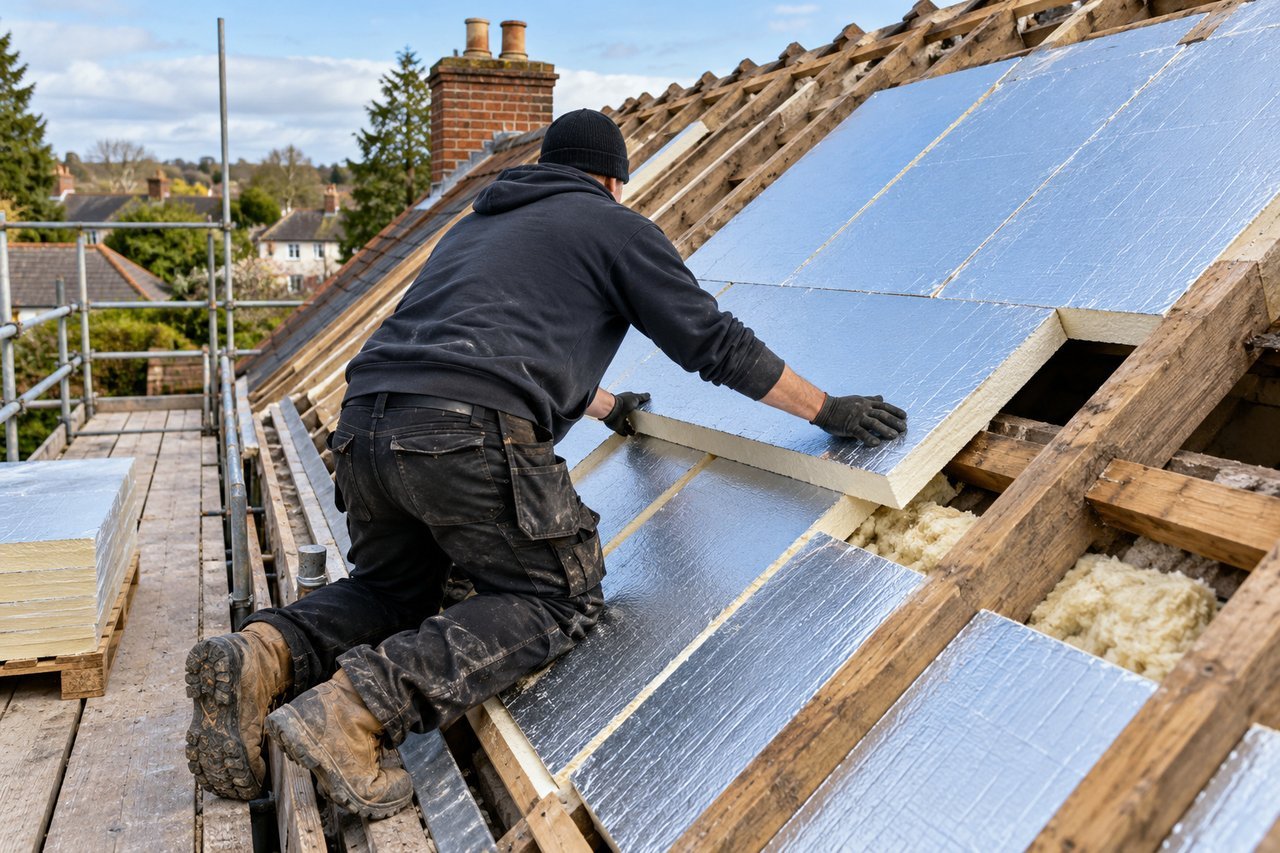
Pitched roof insulation at rafter level means insulating along the slope of the roof, not on the loft floor. It is used where the roof void is lived in, used for storage or has no clear floor to insulate. This page explains the methods, the checks and typical costs.
Last checked: 22 October 2026.
Book a free retrofit assessment
When rafter-level insulation is used
Standard loft insulation sits on the loft floor and is the first choice where the roof void is unused. Rafter-level work is used when the roof space is heated, converted or planned for use. The Energy Saving Trust says insulation typically goes between and over the rafters.
If you only need insulation on an unused loft floor, see our loft insulation guide. For attic bedrooms, see room in roof insulation. For an overview of roof types, see roof insulation.
Between the rafters and over the rafters
| Method | What it is | Points to check |
|---|---|---|
| Between the rafters | Insulation boards or quilt fitted in the gaps between rafters | Depth of rafters, ventilation gap, thermal bridging |
| Over the rafters | Boards laid over the rafters, often with a new roof covering | Roof covering condition, height, planning |
| Under the rafters | A layer fitted below the rafters, inside the room | Reduces headroom, lining and finish |
This table is our summary of standard methods. Real jobs often combine two layers.
Warm roof, cold roof and ventilation
In a cold roof, insulation sits below the roof structure and the space above stays ventilated. In a warm roof, insulation sits at rafter level and the structure is kept warm. Each method has its own ventilation rules, and getting them wrong can trap moisture. A trained installer sets this out in the survey.
How pitched roof insulation affects an EPC
Treating the roof improves fabric performance, the lead measure on the new EPC under confirmed policy that is not yet law. Because rafter-level insulation is less efficient than a standard loft layer, we model your home first and show the result. The EPC C by 2030 rule is confirmed government policy, not yet law.
Common faults at rafter level
These are the points our survey looks for. They come from standard building practice, not from a single source.
- Blocked ventilation at the eaves, which can trap moisture.
- Insulation squashed into a gap that is too shallow, which lowers its performance.
- Gaps at the ridge, the eaves and around chimney breasts.
- No air or vapour control layer on the warm side, where the design needs one.
- Cold bridging through the timbers when only the gaps between rafters are filled.
Pitched roof insulation grants in Greater Manchester
Roof insulation sits on the measure list of the Warm Homes Local Grant, run by GMCA. Eligible landlords are those signed up to the Good Landlord Charter, with homes rated D or E and a tenant on a qualifying route. See the Warm Homes Local Grant guide and the grants for landlords guide. ECO4 closes on 31 December 2026.
Pitched roof insulation cost
Researched costs depend on the roof area, the boards or quilt used and the lining.
| Work | Figure found | Source and date |
|---|---|---|
| Insulation per square metre | £14 to £24 | MyJobQuote, July 2026 |
| Whole job | £1,200 to £3,000 | Less.co.uk, April 2026 |
These are market figures, not our quote. Our written price follows the survey. Spend since 1 October 2025 counts towards the £10,000 cap.
How the process works
- Inspection: an assessor checks the roof covering, rafters and ventilation.
- Scope: a written list names the method and thickness.
- Fitting: our installer fits and seals the layers.
- Handover: certificates arrive for your cap evidence.
- Records: keep the scope, invoices and any building control sign-off together for future buyers and assessors.
Who delivers the work
Compliant Lets is a trading name of LAMTANS Holdings Ltd. The work is delivered by LAMTANS Engineering Ltd, which holds PAS 2030, PAS 2035 and TrustMark.
Adviser tip, from a Retrofit Coordinator: ask the installer to name the ventilation route in writing. A quote that skips it can look cheaper and cost more if moisture gets in.
Sources
- Energy Saving Trust: Roof and loft insulation guide, checked 21 October 2026
- Planning Portal: Roof insulation and thermal resistance, checked 22 October 2026
- GMCA: Warm Homes Local Grant, privately rented scheme, checked 21 October 2026
- GOV.UK: Improving the energy performance of privately rented homes, government response, checked 22 October 2026
- MyJobQuote: loft and roof insulation cost, July 2026 figure
- Less.co.uk: roof insulation cost, April 2026 figure
Designed & developed by LAMTANS Technologies LLC, USA — part of the LAMTANS Group
Frequently asked questions
What is rafter-level insulation?
It is insulation fitted along the slope of the roof, between, over or under the rafters, not on the loft floor.
When do I need it instead of loft insulation?
When the roof space is lived in, heated or used, or when there is no clear loft floor to insulate.
Is it more expensive than loft insulation?
Usually yes. The Energy Saving Trust says rafter-level insulation costs more than a standard loft layer. We give a written price after the survey.
Will it need building regulations approval?
Possibly, if the roof covering is renewed or the use of the space changes. Check with building control or ask at the survey.
Do I need to ventilate the roof?
Yes in many designs. The ventilation route depends on whether the roof is warm or cold. The survey sets it out.
Can I claim a grant?
Possibly, under the Warm Homes Local Grant in Greater Manchester, if landlord, home and tenant all qualify. ECO4 closes on 31 December 2026.
Does it count towards the £10,000 cap?
Yes, when installed since 1 October 2025, along with any third-party funding. Keep invoices and records.
Will it get my home to EPC C?
It helps, since fabric leads on the new EPC. The final result depends on the whole house, which the assessment models.